












.jpg?cx=0.5&cy=0.5&cw=150&ch=120&blr=False&hash=27326E4FE66B0A2BFABAF4995DA29DC5)





How to Match Foundation When You're Between Shades
August 19, 2026

Key Takeaways
- Skin with cool, warm, neutral, or olive undertones may need different foundation adjustments even when the depth looks right.
- The jawline is the most useful place to test foundation because it shows how the shade connects the face and neck.
- Foundation can appear to shift after dry-down, so daylight testing helps separate oxidation from undertone mismatch.
- Mixing two neighboring shades works best when the formulas have the same finish and texture.
- A near-match shade can also be softened with moisturizer, bronzer, strategic placement, or lighter layers.
What Should You Know Before Matching Foundation?
First things first: Before you start mixing or applying foundation, it helps to understand three essentials—skin depth, undertone, and where to test your shade. These factors determine if a foundation is truly too light or too dark, or if it’s the undertone that’s throwing the shade off.
Undertone is especially important—and often overlooked. It’s the subtle cast beneath the surface of your skin, usually categorized as cool, warm, neutral, or olive. Unlike your surface skin tone (which can change with sun exposure or redness), undertone stays consistent. A foundation that matches your skin’s depth but clashes with your undertone can make your complexion look orange, pink, yellow, gray, or just a bit dull.
Where you test foundation matters, too. Swatching on your hand or arm might seem easy, but the skin there can be a noticeably different color than your face. For the most accurate match, swipe your foundation along your jawline—this area shows how the shade transitions between your face and neck, making it easier to spot a seamless color blend.
How Do You Find Your Foundation Undertone?
A few simple checks can help identify your undertone. Veins that appear mostly blue or purple often point to cool undertones, while green-looking veins often point to warm undertones. If the veins appear somewhere between blue and green, the undertone may be neutral.
Undertone Indicators
- Cool:
- Veins appear blue; skin may have a pink, red, or bluish tint.
- Silver jewelry flatters your skin tone best.
- Cream-colored clothing complements you more than white-colored clothing.
- Warm:
- Veins appear green; skin may have a yellow, golden, or peachy hue.
- Yellow gold jewelry flatters your skin tone best.
- White-colored clothing complements you more than cream-colored clothing.
- Neutral:
- Veins are a mix of blue and green; skin is not distinctly pink or golden.
- Both silver and yellow gold look equally as flattering.
- Both white and cream-colored clothing complement your skin tone.
- Olive:
- Skin may look muted, greenish, golden-gray, or slightly ashy with foundations that are too pink or too orange.
- The above jewelry test feels inconclusive or confusing.
How to Test Foundation for the Best Match
The jawline is one of the most useful places to test foundation because it shows whether the shade connects the face and neck without a visible line. A good near-match should soften the transition between both areas and avoid looking noticeably lighter, deeper, warmer, or cooler.
Start by applying two to three vertical stripes of foundation along the jawline, then blend the edges slightly. Check the swatches in natural daylight after the formula has settled. The shade that appears most balanced against both the face and neck is usually your strongest option.
How Do You Mix Foundation Shades?
If you’re between foundation shades, that usually means one shade looks close in some areas but too pale, deep, orange, pink, yellow, or gray against other areas—like the jawline or neck. A custom mix can bridge that gap by combining two nearby shades, testing the blend in daylight, and recording the formula for repeat use.
Step 1: Confirm You’re Really Between Shades
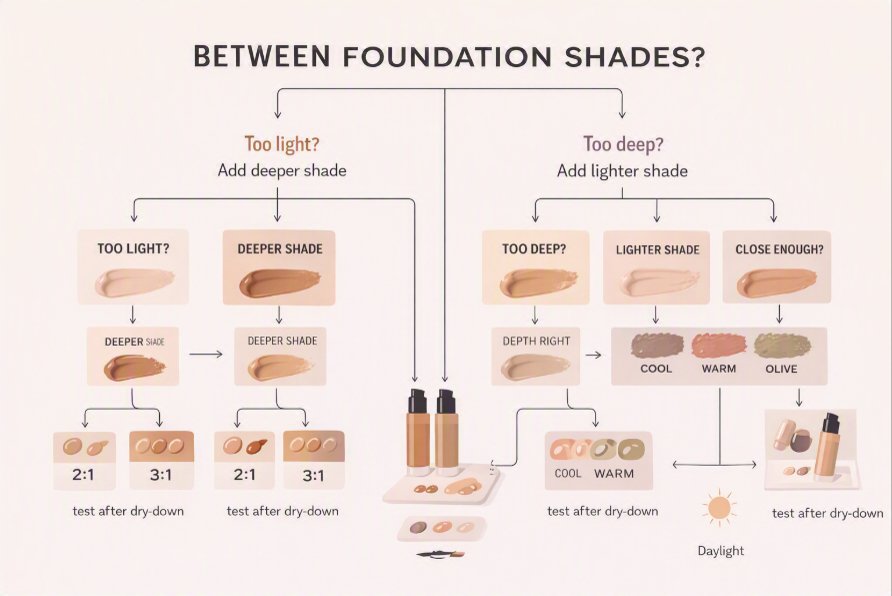
Swatch the lighter shade, the deeper shade, and a custom mix along the jawline, extending slightly onto the neck. If the lighter shade makes the complexion look washed out and the deeper shade creates a visible edge, the issue is likely a depth gap rather than undertone alone.
Make sure to check the swatches in natural daylight after the foundation has had time to settle. Indoor lighting, flash photography, and oxidation can change how a shade appears after the first application. This step helps identify the most seamless-looking option without promising an exact or universal match.
Step 2: Mix Light and Dark Shades Using Ratios
Start with a 2:1 mix when the lighter shade is close but slightly pale: two parts light foundation to one part deeper foundation. Use a 3:1 mix when only a small amount of depth is needed. If the deeper shade is closer, reverse the ratio and add the lighter shade gradually until the blend looks more balanced.
Use a clean mixing palette, stainless steel spatula, brush, or disposable applicator rather than dipping fingers directly into the product. Mix only the amount needed for one application, then wash tools after use. Avoid storing homemade foundation blends unless the packaging and formula are designed for that purpose.
Foundation Mixing Ratios for Two Close Shades
Use the below ratio guide as a starting point, then adjust in small increments based on how the blended shade looks along the jawline after dry-down.
| Starting Point | Example Mix | When to Use |
| Lighter shade is close | 2 parts light + 1 part deep | When the lighter shade is slightly pale |
| Only slightly too light | 3 parts light + 1 part deep | When a small depth adjustment is needed |
| Darker shade is close | 2 parts deep + 1 part light | When the deeper shade is slightly too rich |
Why Does Foundation Look ‘Off’ Even When the Shade Depth Is Right?
It’s a familiar struggle: your foundation looks perfectly light or deep enough, but the color still seems off—sometimes turning orange, pink, yellow, gray, or just flat. That’s often because the undertone isn’t quite right. When the pigment balance doesn’t align with your skin’s undertone, it can throw off your entire look—no matter how accurate the depth. In these cases, correcting undertone becomes more important than just finding a lighter or darker shade.
For example, pink undertones can make a base appear too rosy or cool, while yellow undertones might make your skin look overly golden or even sallow. Olive undertones? They often need foundation with a more neutral or muted yellow-green balance to prevent an orange or gray cast. Undertone-adjusting drops are a great option to fine-tune your match—just remember, a tiny bit goes a long way, as overcorrecting can cause a whole new mismatch.
Don’t forget about face-to-neck harmony, either. Your face may be slightly lighter, redder, or more pigmented than your neck (thanks, sun exposure and skin conditions). Instead of matching only the center of your face, swipe foundation along your jawline and blend slightly onto your neck—this ensures your shade works across both areas for a seamless look.
How Do You Fix a Foundation Shade That Looks Too Light, Orange, or Yellow?
- Too light: This usually points to a depth mismatch. Mix in a deeper shade from the same formula in small amounts, then swatch the blend along the jawline before applying it to the rest of the face.
- Looks orange: Orange tones can come from oxidation or an undertone mismatch. Let the foundation dry down, check it in natural light, then adjust gradually with a cooler or more neutral base if the shade still looks too warm.
- Too yellow: A yellow cast usually means the undertone is too warm for the skin. Try a more neutral or cooler shade, or use an appropriate undertone adjuster sparingly to soften the yellow tone without overcorrecting.
- Looks too pink: A pink cast may mean the base is too cool. A neutral or warmer shade may help balance the color without making the foundation look overly golden.
- Looks gray or ashy: A gray cast can happen when the depth is too light, the undertone is too cool, or the formula does not have enough warmth for the skin tone. Try a slightly deeper or more balanced shade.
- Doesn’t match the neck: The issue may be placement rather than the foundation itself. Swatch across the jawline and blend slightly toward the neck so the shade can be judged where the face and neck meet.
How Seasonal Shade Changes Affect Your Foundation Match
Foundation shade needs often shift between summer and winter, thanks to changes in sun exposure, outdoor activities, travel, and general lifestyle. Your perfect summer shade might look too deep or warm as your skin naturally lightens in the colder months, while your winter shade could appear too pale after time spent outdoors. That’s why it’s smart to keep a second shade on hand—or even custom blend between them—as your complexion changes throughout the year.
How Can You Fix a Foundation Shade Without Mixing?
A near-match foundation can often be softened without mixing two shades. Sheer the formula with moisturizer for lighter coverage, apply coverage mainly to the center of the face, or use bronzer strategically around the perimeter when the base is slightly too light. Thin layers also help the color blend more naturally than one heavy application.
Foundation Options for Shade Matching and Mixing
When your foundation shade is close—but not quite perfect—the right formula can make all the difference. Blendable foundations work well for custom mixing, allowing you to tweak undertone or depth with ease. If you’re nearly there with a shade, try layering a sheer skin tint to soften and blur minor mismatches. Prepping skin with hydrating products can create a smoother canvas, while adding a touch of bronzer helps balance your base and blend the color seamlessly from face to neck.
Ideal for an Extensive Shade Range
L'Oréal Paris True Match Super-Blendable Foundation
Why It's Ideal: With 47 skin-like shades, this foundation is designed to assist in finding a suitable match. The updated formula includes up to six different pigments for even more precise, true-to-skin results. Shades are organized by undertone (Warm, Neutral, Cool) to help you zero in on your best fit—or easily mix two shades from the same range for a custom blend. The liquid texture is designed for smooth blending, making it ideal for both everyday wear and shade-matching adjustments.
Who Can Use: Anyone needing to create a highly specific, custom-blended foundation shade.
Key Ingredients:
- Glycerin
- Dimethicone
- Vitamin E
Ideal for a Luminous Matte Finish
Maybelline Super Stay Lumi-Matte Foundation
Why It's Ideal: This foundation boasts a polished matte finish, while also providing a flexible, blendable base. As a long-wear foundation, it supports comparisons across undertone, depth, and seasonal shade shifts, which can assist in shade matching. Plus, the formula offers up to 30 hours of wear and comes in 24 shades, allowing for consistency throughout the day.
Who Can Use: Anyone who needs a longer-wear foundation option for custom mixing, all-day shade testing, or events where a near-match base needs to remain balanced.
Key Ingredients:
- Octinoxate (Sunscreen)
- Titanium Dioxide (Sunscreen)
- Dimethicone
Ideal for a Matte, Pore-Blurring Finish
Maybelline Fit Me Matte + Poreless Foundation
Why It's Ideal: This is a useful foundation when a near-match shade needs a smoother matte finish. The formula is especially relevant for combination or oily skin because excess shine can make color differences around the jawline, nose, and forehead appear more noticeable. It comes in 40 true-to-tone shades ranging from very light to deep, with options for warm, neutral, and cool undertones. It works well for controlled swatching, daylight testing, and subtle mixing.
Who Can Use: Anyone with combination or oily skin who wants a matte foundation option for shade testing, custom mixing, or a near-match base.
Key Ingredients:
- Dimethicone
- Glycerin
- Perlite
Ideal for a Flexible Skin-Like Tint
L’Oréal Paris True Match Hyaluron Tinted Balm
Why It's Ideal: This tinted balm supports a softer, more forgiving approach to shade matching. The lightweight coverage can help reduce the look of a harsh line of demarcation while still evening the look of skin tone, making it useful when an exact foundation match is difficult to find. It comes in 12 shades and contains 80% skincare ingredients, including hyaluronic acid, and offers a flexible option for a lighter, skin-like complexion finish.
Who Can Use: Anyone who wants a lighter, skin-like complexion option that can soften the appearance of a near-match shade.
Key Ingredients:
- Firming Serum
- Glycerin
- Hyaluronic Acid
FAQ — Your Foundation Matching Questions, Answered
How do you know if foundation is oxidizing or just the wrong undertone?
Oxidation usually shows up after foundation has been on the skin for several minutes and may make the shade look darker, warmer, or more orange than it looked in the first swatch. An undertone mismatch is usually visible right away: the shade may look too pink, too yellow, gray, or dull even before dry-down. Testing in natural daylight after the formula settles helps separate the two issues.
Can concealer adjust a foundation shade?
Concealer can adjust a foundation shade in a pinch, but it may change the finish, coverage, or texture because concealers are often thicker and more pigmented than foundation. For a more consistent mix, two shades of the same foundation formula usually blend more predictably. Concealer works best for small spot adjustments, not full-face shade correction.
Product selections are made using editorial research and brand knowledge; personal use or testimonials are noted where applicable.


Read more